
Site Investigation (Soil Investigation)
What is Site Investigation?
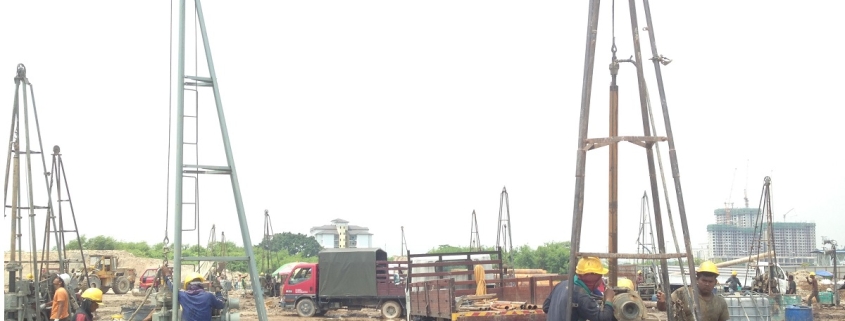
Site Investigation (S.I.), commonly known as Soil Investigation in Malaysia, is crucial in all construction projects. Site Investigation is usually performed by drilling boreholes into the ground to obtain information on the physical properties of soil and rock around a site, for the purpose of earthworks and foundation design of the proposed structures. The same techniques are also applicable for the repair of distress to earthworks and structures caused by subsurface conditions.
Foundtest Drilling Sdn Bhd is a CIDB registered drilling contractor carrying out site investigation works nationwide across Malaysia.
To obtain information about the soil conditions below the ground, some form of subsurface exploration is required. Methods of observing the soils below the surface, obtaining samples, and determining physical properties of the soils and rocks include test pits, boring and in-situ tests.
Test pits can be hand dug with a shovel or machine excavated up to 5 metres deep for the purpose of soil sample collection and observing soil condition. This technique is usually applicable only for low rise developments that do not involve deep foundations.
For deep soil boring, the most commonly used technique is Rotary Wash Boring, where our drilling rigs can bore to 80 to 100 metres depth depending on site condition. Disturbed and undisturbed soil samples can be collected by split spoon (SPT sampler), piston sampler, thin wall tube and Mazier sampler. When a rock layer is reached, coring can be used to core through the rock and collect rock samples.
In-situ tests commonly carried out during soil investigation include the Mackintosh Probe Test, Standard Penetration Test (SPT), Vane Shear, Dynamic Cone Penetration (DCP) and Cone Penetration Test (CPT).
All results and findings obtained from Site Investigation works are presented in a Factual Geotechnical Report, which consists of borelogs with soil descriptions and in-situ test results, together with laboratory test results.
Below are detailed descriptions of the typical terms and techniques commonly used in Site Investigation works.
Methods of Subsurface Exploration
Soil Boring (Rotary Wash Method)
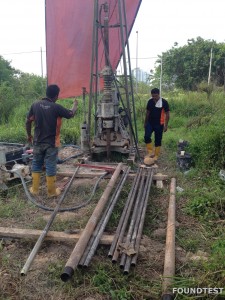 Rotary Wash Soil Boring
Rotary Wash Boring is one of the most common methods used to drill a borehole during Site Investigation work. Drilling fluid, usually water, is used to flush off soils to create a borehole in the ground with steel casing which is rotated by the drilling machine. The purpose of drilling a borehole is to allow access into deep ground to carry out other in-situ tests, sampling and installation of monitoring instruments at designated depths. This method is capable of drilling to approximately 80 to 100 metres depth depending on ground condition.
JKR / Mackintosh Probe Test
The JKR / Mackintosh Probe Test is a quick and economical way to estimate the bearing capacity of a soil layer by correlating cone penetration resistance to bearing capacity. It can reach a maximum depth of 15 metres and is recommended only for shallow foundations. This method cannot collect soil or rock samples and cannot report soil type. It is also unsuitable for rocky areas.
For full details of the method, read the JKR / Mackintosh Probe Test page.
Hand Auger
Hand auger drilling is carried out using a hand-held auger which is manually drilled into the ground to obtain soil samples. The drilled depth is very limited, usually less than 5 metres, due to the limitation of human power. This method is considered only under special circumstances, such as where drilling fluid is not permitted or the borehole location is inaccessible to drilling machines. It does not give any soil resistance value, and is unsuitable in sandy or high water table areas because the open auger hole will tend to collapse.
Trial Pit and Test Pit
A test pit is carried out by excavating the ground to a designated depth, not more than 5 metres deep, to observe the soil profile underneath and collect bulk samples. Test pits can be hand dug with a shovel or machine excavated, and are usually applicable only for low rise developments that do not involve deep foundations.
In-Situ Testing
Standard Penetration Test (SPT)
 Standard Penetration Test (SPT)
The Standard Penetration Test (SPT) is one of the most common field tests used to determine driving resistance in soil strata. This method is carried out in accordance with BS 1377:1990, “Determination of the penetration resistance using a split barrel sampler and a self tripping hammer of approved design”. The result is presented as the SPT-N value, which indicates blow count per 300 mm penetration.
SPT equipment consists of a 63.5 kg hammer, hammer fall guide, anvil, automatic hammer release system and a split barrel sampler. The test is carried out by repeatedly driving the split barrel sampler into the ground at the desired depth level, usually at 1.5 metre intervals, using an automatic hammer release system that allows the 63.5 kg hammer to free fall through a drop height of 0.76 metres. The number of blow counts to achieve 75 mm penetration is recorded, and the procedure is repeated six times for a total of 450 mm penetration.
The first two layers of 75 mm penetration each are considered seating drive and are not counted in reporting the SPT-N value. The total number of blow counts within the final 300 mm of penetration, separately recorded for every 75 mm, is taken as the SPT-N value.
Soil samples recovered from the split barrel are preserved as disturbed samples for subsequent testing in the laboratory.
Rock and Cavity Probing
Rock and cavity probing is carried out to determine the exact depth of bedrock and the existence of cavities. This information is highly valuable during the piling stage and can have a significant impact on the cost and design of the piling foundation, particularly where a development is carried out in a limestone area. Cavity grouting can be carried out where cavities are encountered.
Rock and Soil Sampling
Rock and soil sampling is one of the most important elements of Site Investigation work. It provides an in-depth understanding of the type of material present and its characteristic behaviour in the substrata.
Soil samples can be obtained using various techniques depending on soil condition, and are classified as either Disturbed (D) or Undisturbed (UD). Disturbed samples are usually collected using the SPT split barrel, while undisturbed samples are extracted using a block sampler box, UD tube, piston sampler or Mazier sampler. The samples collected are used as specimens in laboratory tests for classification, strength, consolidation and chemical content.
Rock samples are extracted from deep ground using a diamond core bit with core barrel. The Core Recovery Ratio (CRR) and Rock Quality Designation (RQD) are reported for each core run.
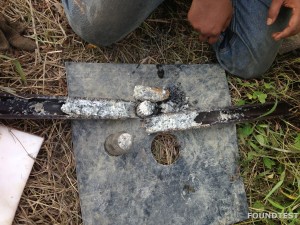
Disturbed Soil Sampling
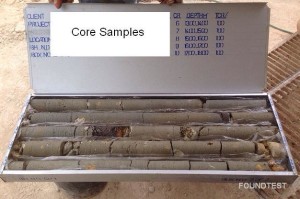
Rock Core Sample
Geotechnical Laboratory Testing
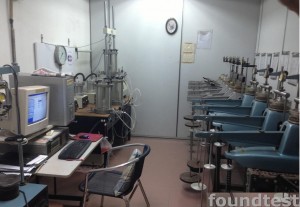 Geotechnical Laboratory
As a one-stop geotechnical soil investigation contractor, Foundtest Drilling also provides laboratory testing services. All construction materials, soil samples (disturbed and undisturbed) and rock samples collected on site can be tested in our associate laboratories according to the requirements of the client or design engineer.
Laboratory Soil Tests to BS 1377:1990
| Test | Standard Reference |
|---|---|
| Moisture content | Part 2, Method 3.2 |
| Atterberg limits (LL, PL, PI) | Part 2, Methods 4 & 5 |
| Linear shrinkage limit | Part 2, Method 6.5 |
| Bulk density | Part 2, Method 7.2 |
| Specific gravity (particle density) | Part 2, Method 8 |
| Particle size distribution – coarse grained | Part 2, Methods 9.2 & 9.3 |
| Particle size distribution – fine grained | Part 2, Method 9.5 |
| Unconfined compression test (UCT) – 38, 50 and 70 mm diameter, 1 specimen each | Part 7, Method 7.2 |
| UU triaxial compression test without p.w.p. – 38, 50 and 70 mm diameter | Part 7, Method 8 |
| CU triaxial compression test with p.w.p. – 38, 50 and 70 mm diameter | Part 8, Method 7 |
| CD triaxial compression test with p.w.p. and volume change – 38, 50 and 70 mm diameter | Part 8, Method 8 |
| One dimensional consolidation test – e vs log pressure, Mv & Cv, t90 graphs | Part 5, Method 3 |
| One dimensional consolidation test – e vs log pressure, Mv & Cv, t50 & t90 and c-alpha | Part 5, Method 3 |
| Direct shear strength, 60 x 60 mm samples – soaked, consolidated drained, 3 specimens | Part 7, Method 4 |
| Laboratory permeability – falling head permeameter (k > E-04 m/s) | K.H. Head, Vol. 2, 10.7.2 |
Chemical Tests on Soil and Water
| Test | Standard Reference |
|---|---|
| pH value | BS 1377 Part 3, Method 9 |
| Total / soluble sulphate | BS 1377 Part 3, Method 5 |
| Chloride content | BS 1377 Part 3, Method 7 |
| Organic matter | BS 1377 Part 3, Method 8 |
| Total dissolved solids | BS 1377 Part 3, Method 9 |
| Salinity | BS 1377 Part 3, Method 10 |
Rock Tests
| Test | Standard Reference |
|---|---|
| Unconfined compressive strength | ASTM D2938-79 |
| UCT with Young’s modulus and Poisson’s ratio | ASTM D3148-80 |
| Point load strength | Broch, E. & Franklin, J.A. |
Instrumentation and Monitoring
Inclinometer
An inclinometer monitors horizontal movement of soil layers to detect ground movement that could lead to soil erosion or other construction problems. Inclinometer casing is installed in the borehole to the required depth, and readings are taken periodically to confirm soil stability.
Standpipe Piezometer
A standpipe piezometer monitors the groundwater table or water pressure, providing data for foundation design and other engineering purposes.
What You Receive – The Factual Geotechnical Report
All results and findings obtained from Site Investigation works are presented in a Factual Geotechnical Report. The report contains borelogs with soil descriptions and stratigraphy, in-situ test results including SPT-N values, groundwater observations, sampling records, Core Recovery Ratio and Rock Quality Designation for each rock core run, and the full laboratory test results.
A factual report presents measured data. Interpretation of that data and the resulting foundation recommendations are prepared by your geotechnical consultant or design engineer.
Site Investigation FAQ
What is the difference between site investigation and soil investigation?
In Malaysia the two terms are used interchangeably. Site Investigation (S.I.) is the formal engineering term covering all investigation of ground conditions, including boreholes, in-situ testing, sampling and laboratory work. Soil Investigation is the common industry name for the same scope. Tender documents and JKR specifications may use either term to describe identical work.
How many boreholes does my project need?
The number is set by your consulting engineer or the project specification, not by the drilling contractor. BS 5930 gives guidance based on the footprint and the type of structure, and a common approach for building projects is a grid across the site with additional boreholes at areas of heavy load or suspected variable ground. Send us the site layout and we can quote against the borehole schedule your engineer has specified.
How deep should the boreholes go?
Termination depth is specified by the design engineer. Boreholes are commonly terminated once a consistent hard stratum is proven, often defined by an SPT-N value threshold sustained over successive runs, or by a specified penetration into rock. Our rotary wash boring rigs can reach approximately 80 to 100 metres depending on ground conditions.
What is the SPT-N value and why does it matter?
The SPT-N value is the number of hammer blows required to drive a split barrel sampler the final 300 mm of a 450 mm penetration, using a 63.5 kg hammer falling 0.76 m, in accordance with BS 1377:1990. The first 150 mm is treated as seating drive and excluded. SPT-N is the primary in-situ measure of soil strength and density, and it feeds directly into foundation design, pile length estimation and bearing capacity calculations.
Should I use a Mackintosh probe or a borehole?
They serve different purposes. The Mackintosh probe is quick and economical, reaches a maximum of about 15 metres, and estimates bearing capacity for shallow foundations, but it recovers no samples and cannot identify soil type. Boreholes with SPT and sampling are required for deep foundation design, for any project requiring laboratory testing, and wherever rock is expected. Mackintosh probing is unsuitable in rocky ground.
What is included in the geotechnical report?
We issue a Factual Geotechnical Report containing borelogs with soil descriptions and stratigraphy, in-situ test results including SPT-N values, groundwater observations, sampling records, core recovery ratio and rock quality designation for rock runs, and the laboratory test results. A factual report presents measured data. Interpretation and foundation recommendations are prepared by your geotechnical consultant.
What is the difference between disturbed and undisturbed samples?
Disturbed samples are recovered from the SPT split barrel and retain soil composition but not in-situ structure, so they suit classification, moisture content and Atterberg limits testing. Undisturbed samples are recovered using thin wall tubes, piston samplers, Mazier samplers or block samplers, preserving in-situ structure so that shear strength, consolidation and permeability can be measured meaningfully.
Why is rock and cavity probing important on limestone sites?
Limestone formations frequently contain cavities and a highly irregular bedrock profile. Probing establishes the true bedrock depth and identifies voids before piling begins. Discovering cavities during piling rather than during investigation can force redesign, extend pile lengths unpredictably and add substantial cost. Where cavities are found, cavity grouting can be carried out before foundation works proceed.
Related Services
- JKR / Mackintosh Probe Test – rapid shallow bearing capacity assessment to JKR requirements
- Ground Improvement – treatment where investigation shows inadequate bearing capacity
- Piling Foundation – deep foundations designed from site investigation data
- Reverse Circulation Drilling (RCD) – large diameter bored piles and rock socketing
- Pile & Foundation Testing – verification testing by our associate company Foundtest (M) Sdn Bhd
Request a Site Investigation Quotation
Send us your site layout and the borehole schedule specified by your consulting engineer, and we will prepare a quotation. Foundtest Drilling is a CIDB registered contractor carrying out site investigation works nationwide across Malaysia.
Call +603-8051 5333, email admin@foundtest.com, or use our contact form.